
What Frege's Platonism Cannot Be

Gottlob Frege’s Begriffsschrift: eine der arithmetischen nachgebildete Formelsprache des reinen Denkens today sits comfortably among the great and fruitful re-thinkings in philosophy.1 But it was received rather tepidly at the time of its publication in 1879, not least because its audience was largely uncomprehending of the nature and purpose of the logico-mathematical system it sets forth. Part of the blame lay with Frege himself: he believed, not unreasonably, that the best introduction to his handiwork would be to get straight to the task of demonstrating what it does, rather than talking about it. He clearly underestimated how helpful it would be to summarize his overall vision. (The renowned Preface to Begriffsschrift does some work to that end, but it does not do enough.)
Had Frege’s project not received such lukewarm reviews, though, we would be without the trove of essays he penned in the immediate aftermath. Between the publication of Begriffsschrift and the publication in 1884 of Die Grundlagen der Arithmetik: Eine logisch-mathematische Untersuchung über den Begriff der Zahl, Frege wrote several papers meant to explain the nature and purpose of his system, taking special care to clarify all the ways it differed from George Boole’s system, to which, at the time, Frege’s was hastily and wrongly assimilated.2
The ambient misapprehension proved to be a blessing for posterity. These post-Begriffsschrift essays are indispensable for fathoming Frege’s basic philosophical commitments and, thereby, the logico-mathematical system they frame.3 Though we find in these essays several insights into Frege’s project, there is one idea in particular I would like to isolate for the purposes of this post. It is an important idea because it stands, I believe, as a sine qua non for any understanding of what Frege’s platonism comes to.
A writing system, curiously designed
Above, I deliberately omitted mention of one of the most significant features of Begriffsschrift, and likely the feature that has thwarted appreciation of Frege’s vision from the beginning. His monograph not only articulates a new way of conducting logical investigation into the foundations of mathematics. It also lays out a writing system of his own invention, which he calls a begriffsschrift, “a writing system for concepts” — after which he names his monograph. Despite Frege’s having tailored it specifically to the kind of logico-mathematical investigation he envisioned for his discipline, his begriffsschrift can strike newcomers as being gratuitously idiosyncratic.
Open Begriffsschrift (the monograph) to its third chapter, where Frege carries out derivations of arithmetically important theorems, and you’ll observe little else on any given page except two-dimensionally arrayed, geometrically intricate glyphs branching rectangularly from the top left corner to the bottom right. The odd interstice might feature a written sentence or two of natural language, but most of the space is given over to expansive, blocky reticulations of lines bedecked with strings of symbols. A future archaeologist would be forgiven for mistaking begriffsschrift writing for a runic conjuration.
Here, for example, is a (comparatively simple) begriffsschrift diagram for the concept of what it is to be a prime number:
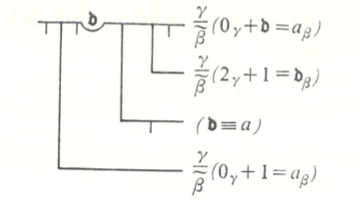
One particularly grumpy reviewer called Frege’s diagrams, such as the one above, “a monstrous waste of space.” Of course, like too many of us, the reviewer had not thought to question whether Frege’s lodestar was the efficiency secured by graphical thrift. Indeed, once you learn to read, draw, and reason in begriffsschrift diagrams like this, you realize how beautiful they are: synoptic, perspicuous, and exquisitely suited to their purpose. What keeps the amateur and the scholar alike from appreciating them is a misunderstanding of what they are meant to do and why they are meant to do it.4
Grasping concepts through their signs
I argue as much, anyway, in my recently defended dissertation, where I uncover, explain, and try to render plausible the philosophical vision in light of which Frege designed his writing system to look the way it does.5 In lieu of the scholarly details, let me simply register that Frege’s vision only makes sense if we recognize its grounding in a particular philosophical anthropology.
That an idea of the whole human being governs Frege’s logico-mathematical project might come as a surprise. As is the case with any thinker whose work is too rich to be mastered in one course, let alone one unit or lesson, Frege’s ideas circulate, inside and outside the academy, in attenuated caricature. The caricature is invoked as part of potted histories of analytic philosophy, histories formal and informal, passed down from teacher to student. And it is nourished by the mass production of journal articles on a paltry handful of Fregean themes. Lost is any indication that Frege was philosophically sensitive to the fact that our logico-mathematical investigations are shaped by the kind of beings we humans are. And yet, even if it often guides only tacitly, a philosophical anthropology does break the surface at crucial points.
One such point is in a remarkable little post-Begriffsschrift, pre-Grundlagen paper, “Über die wissenschaftliche Berechtigung einer Begriffsschrift,” from 1882.6 As shown in its title, the essay explains why the collective project of attaining systematic knowledge (die Wissenschaft) requires careful attention to the design of the writing systems we use in our investigations. Along the way, Frege observes that
we gain the concept only by signifying it, for since it is, in itself, non-intuitable, it requires an intuitable token in order to be able to appear to us.
He is saying three consequential things here. First, if not for our practices of signifying them with perceptible signs, we would be unable to grasp concepts (“we gain the concept only by signifying it”). Second, we signify concepts as a way of enabling their appearance to us (the concept “requires a perceptible token in order to be able to appear to us”). And third — a suppressed premise we are left to articulate for ourselves — signifying has this purpose of enabling the appearance of concepts precisely because it is only by enabling their appearance that we have a chance of grasping them.
In brief, then, Frege’s view is this. Linguistic signs are sites where concepts are able to appear to us, and we need concepts to appear to us because we could not grasp them otherwise. This is why we need signs in order to grasp concepts.
Thus we discern a philosophical anthropology at play. Frege’s logico-mathematical project rests on the observation that while we human beings are able to grasp pure intelligibilia, that grasp is not hermeneutically innocent (to use a phrase from my introductory post). The upshot, as I argue in my dissertation, is that Frege thought the intelligible realm is nothing for us if not inscribable in the sensible realm’s terms.
Concepts, appearing
The point Frege is making here is not that our grasp of concepts properly comes by way of our reading signs for them, though that is an important point. It is that our grasp comes this way only if concepts are made to appear in those signs. Frege is not saying that we need concept-signs to indicate concepts we cannot perceive, nor is he saying that we need concept-signs to serve as substitutes for them. He is saying, rather, that we need concept-signs to do something like what genre paintings do, namely, to give abstract concepts a concrete embodiment and articulation in the sensible world’s terms. Concept-signs here would serve not as tags but as vehicles, providing a medium in which the concept shows itself to us.
Concepts, then, on Frege’s view, need not stay hidden behind, beyond, or otherwise apart from their signs, which, for their part, need not merely gesture in the direction of their concepts. Concepts do not repose, crystalline and untouched, in a realm forever separated from the sensible one. Instead, there are signification regimes that make them present in our signs, necessarily formed, though they are, by the sensible medium in which, and only in which, they can appear to us. Concept-signs can be sites where the intelligible and sensible dimensions intersect, where we experience the intelligible’s embodiment in the sensible.
Understanding Frege’s platonism
Why does this semiotic-hermeneutic vision of Frege’s matter?
One way it matters is that there is a long history of ascribing this or that rather unsubtle version of platonism to him, and from what I can tell, none of these ascriptions takes this semiotic-hermeneutic vision into account.
To be clear, the question of whether Frege is a platonist does not concern me here. My concern, rather, is to present his semiotic-hermeneutic vision as a sine qua non of any account of his platonism. If a platonism is discernible in his work, it is, like Plato’s platonism, more subtle and interesting than it is often made out to be.
And so when Frege says that we must recognize a “third realm,” neither physical nor psychological in nature, to which imperceptible and “unowned” intelligibilia belong; that “the history of a concept is really the history of our attempts to grasp it;” that when one grasps a concept one “does not create it but only comes to stand in a certain relation to what existed already” — when Frege says such things, they need to be understood in light of his requirement that such ideal beings can nonethless appear to us in perceptible form.7
Whatever Frege’s platonism comes to, if a platonism there be, it cannot be a platonism that forecloses the possibility of intelligibilia being present in — appearing to us in guise of — certain signs we make for precisely that purpose.
English translation: Writing System for Concepts: A Formula Language of Pure Thought Modeled on That of Arithmetic.
English translation: Foundations of Arithmetic: A Logico-mathematical Investigation into the Concept of Number.
Although these essays did not become available in English translation until 1972, the half-century since should have provided plenty of time for Anglo-American Frege scholarship to incorporate their insights. But they have not received the uptake I feel they deserve.
Almost every Frege scholar translates begriffsschrift formulas into contemporary notation without ado, presupposing thereby that nothing important is lost in the translation — that begriffsschrift formulas and contemporary formulas serve the same purpose. I am not implying the presupposition is wrong; I am implying it should not go unquestioned.
I defended my dissertation, Der Ausdruck Eines Inhaltes zur Einsicht: On the Semiotics of Frege’s Begriffsschrift, in December 2025, and it was made publicly available in February 2026. If you are interested, you may download or read it here.
English translation: “On the Scientific Justification of a Begriffsschrift.”
Many of Frege’s platonistic remarks figure in a 1912 essay called “Der Gedanke: Eine logische Untersuchung” (“Thought: A Logical Investigation”).
Wonderful article, sir.
Maybe your could help clarify something for me. Taking the ‘vehicles not tags’ concept and placing it next to the idea of the third realm, the image that comes to mind is a bridge. I suspect I’m being ridiculous, but I read a lot of Richard Scarry books these days, and that’s the imagery that leapt to mind as I read this.
The difficulty of the system* and the intent of human-centeredness makes me expand this image a bit more: It’s fine to have a picture of the things on the other side of the river, and we can grasp quite a lot about how things work over there in the third realm, but to approximate an embodied experience of that realm, to get as close to it as possible, requires something beyond the tools which, though serviceable for most purposes on this side of the river bank, fall short of getting us close enough to touch the border between this world and that one. For that, you need to build a bridge.
*I’m not familiar with begriffschrift, but reading the description reminded me of this visualization of lambda calculus, which I add here only because it’s beautiful to watch: https://youtu.be/RcVA8Nj6HEo?si=Ld4lqH2YwKs4_42d